
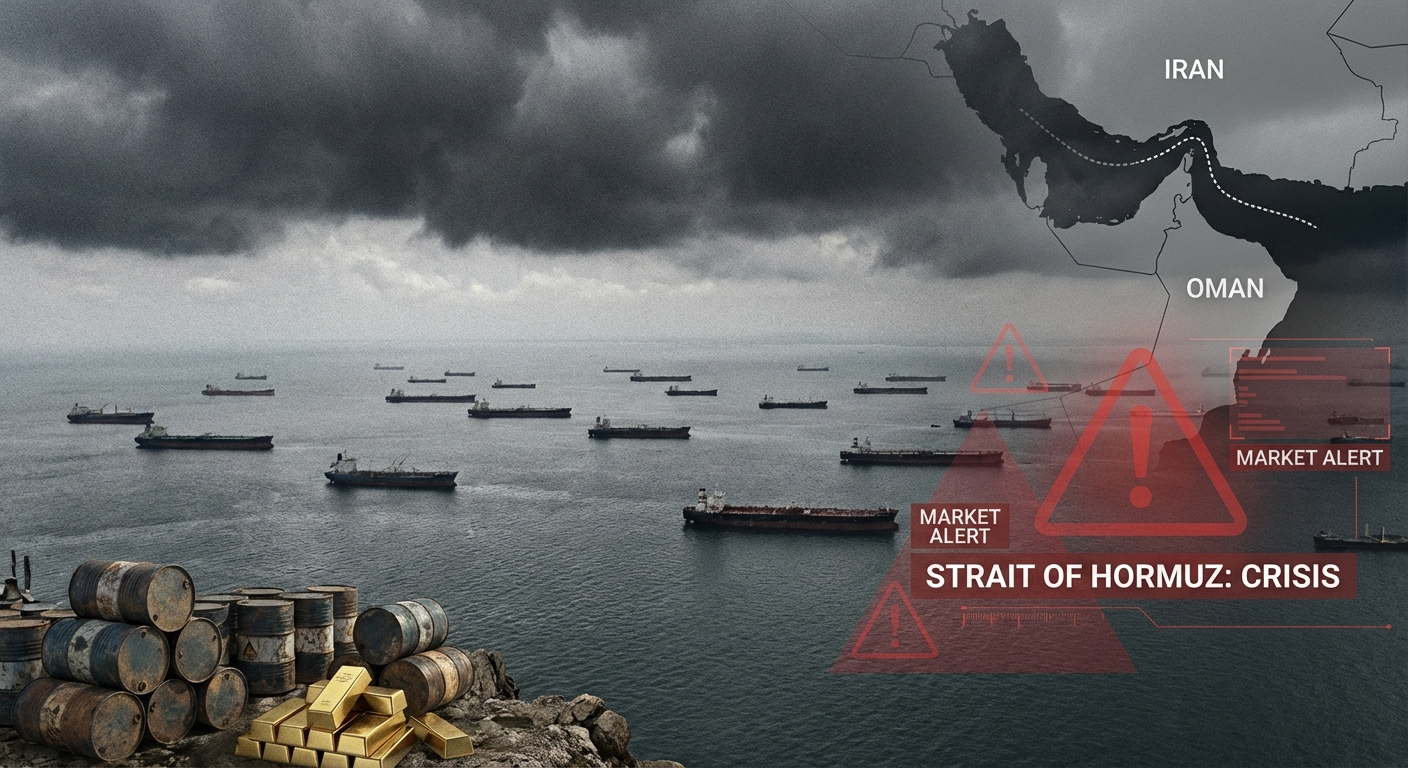
The Strait of Hormuz Just Shut Down — What It Means for Oil and Gold
The world's most critical oil chokepoint is effectively closed. 20 million barrels a day — gone. Here's the ripple effect on energy, commodities, and gold.
What Just Happened to the Strait of Hormuz
On February 28, 2026, the United States and Israel launched coordinated strikes on Iran. The response from Tehran came within hours — not just in the form of retaliatory missiles, but through the most economically devastating weapon in Iran's arsenal: closing the Strait of Hormuz.
The 21-mile-wide chokepoint through which 20 million barrels of oil flow every day — 20% of global seaborne trade — was declared off-limits. What followed was a cascading shutdown that the energy markets had feared for decades.
US-Israel Strikes on Iran
Coordinated strikes launched. IRGC immediately transmits VHF radio warnings to all vessels: no ships permitted to transit the Strait of Hormuz. Tanker captains begin diverting.
Tanker Traffic Down 70% — Oil Surges 9%
Brent crude jumps to $79.45/barrel (+9%). WTI rises to $72.74 (+8.4%). Tanker traffic through the strait drops 70% as captains refuse to risk transit. First vessel attacks reported.
Strait Effectively Closed — Brent at $82
No ships broadcasting AIS signals appear in the strait. A senior IRGC official officially confirms the strait is closed, threatening any vessel that attempts passage. Brent crude hits $82 — a 14-month high, 13% surge in 48 hours.
14+ Vessels Attacked — Brent Peaks at $92–94
IRGC claims "complete control" of the strait. 14+ vessels attacked including oil tankers, container ships, and bulk carriers. 4 seafarers killed. Brent crude surges to $92–94/barrel. Maersk, CMA CGM, Hapag-Lloyd all suspend transits.
Insurance Withdrawn — Transit Economically Impossible
Protection and indemnity insurers withdraw coverage effective March 5, making transit not just dangerous but commercially impossible. Houthi-controlled Yemen announces resumption of attacks on vessels in the Red Sea. Strait declared a "high risk zone."
The scale of this disruption: The Strait of Hormuz carries Saudi Arabia, UAE, Iraq, and Qatar's oil exports. 84% of crude passing through is bound for Asian markets — China, Japan, South Korea, India. The LNG route for European imports from Qatar is also blocked. Europe gets 12–14% of its LNG through this strait.
The Oil Shock — Prices and What Analysts Are Forecasting
The numbers tell a story of a market caught entirely off guard. Pre-war, Brent crude was trading at approximately $67/barrel — already below many forecasts. What followed was one of the most violent oil price moves in decades.
The Price Trajectory
- Pre-war (Feb 27): Brent crude ~$67/barrel
- March 1: Brent $79.45 (+9%) | WTI $72.74 (+8.4%)
- March 2: Brent $82 (+13% in 48h, 14-month high)
- March 3–4 peak: Brent $92–94/barrel (+40% from pre-war)
Analyst Forecasts
Bernstein raised its 2026 Brent forecast from $65 to $80, while noting that a prolonged closure scenario could push prices to $120–150/barrel. Multiple desk analysts are now flagging $100/barrel as a near-term possibility if no resolution emerges within weeks.
"If the Strait of Hormuz remains closed for more than 30 days, we are looking at a structural energy crisis not seen since the 1973 oil embargo. The difference now is that global inventories are leaner, spare capacity is lower, and the alternative routes are longer."
Why There Are No Easy Alternatives
Saudi Arabia has the East-West Pipeline (capacity ~5 million barrels/day) and the UAE has the ADNOC Habshan-Fujairah pipeline (capacity ~1.5 million barrels/day). Combined, these handle roughly 6–7 million barrels/day — less than a third of the 20 million barrels/day that normally passes through Hormuz. The rest has nowhere to go.
How Oil Prices Ripple Into Gold
The relationship between oil and gold is not simple — and the current situation illustrates why. There are forces pushing gold higher, and forces pushing it lower, operating simultaneously.
Forces Pushing Gold Higher
- Inflation fears: Energy costs feed directly into inflation. When oil surges 40%, transportation, manufacturing, and food costs follow. Inflation erodes fiat currency purchasing power — gold is the classic hedge.
- Economic uncertainty: An energy crisis threatens global growth. Markets price in recession risk, which drives safe-haven flows into gold.
- Petrodollar recycling: Oil-exporting nations (Saudi Arabia, UAE, Iraq) historically convert a portion of oil revenues into gold reserves. Higher oil revenues, historically, have meant higher gold demand from sovereign wealth funds.
- Commodity supercycle: When oil rises sharply, all commodities tend to follow — raw material inputs become more expensive, pushing commodity prices broadly higher. Gold rides this wave.
- Geopolitical premium: War in the Gulf is the textbook definition of the geopolitical risk that gold is held to hedge. The safe-haven premium in gold surges.
The Counterforce — Dollar Strength
Here is the paradox that played out in real time. An oil shock triggers inflation fears, which leads markets to expect the Federal Reserve will delay rate cuts (or even raise rates). Higher real rates support the dollar. And since gold is priced in dollars globally, a stronger dollar creates mechanical headwinds for the gold price.
This is exactly what happened in early March 2026. Gold surged to $5,300+ in the immediate aftermath of the strikes (pure safe-haven demand). Then, as the oil shock set in and dollar strength built, gold pulled back to $5,078–$5,100 over March 3–4. By March 5, gold had recovered to $5,183 — still elevated but below the panic highs.
The net effect: Gold remains elevated on the geopolitical premium — the war risk is real, persistent, and unresolved. But the oil-driven dollar strength is acting as a cap, preventing gold from extending its gains as aggressively as the raw safe-haven story would suggest. This is a normal pattern in energy-driven geopolitical crises.
Gold Price Timeline
- Feb 28 (post-strikes): Gold $5,300+ — pure safe-haven surge
- Mar 3–4: Gold pullback to $5,078–$5,100 — dollar strengthens on oil-driven inflation fears
- Mar 5: Gold $5,183 — recovering as geopolitical premium reasserts
On Bahrain's Doorstep — Why This Is Personal
For most of the world, the Strait of Hormuz is an abstract concept — a chokepoint on a map, a percentage in an energy security report. For Bahrain, it is the water outside the window.
Bahrain is located directly on the Arabian Gulf, adjacent to the strait. The crisis is not happening "in the region" — it is happening here. And the consequences have arrived directly:
- The Stena Imperative attacked at Bahrain port: The US-flagged vessel Stena Imperative was struck twice while docked at the Port of Bahrain. A port worker was killed — a Bahraini casualty in a war fought on regional waters.
- Retaliatory missiles: Iran launched retaliatory missile strikes at US military bases in Gulf states, including Bahrain, which hosts the US Navy's Fifth Fleet headquarters at NSA Bahrain.
- Economic exposure: Bahrain's economy is directly tied to the strait — oil exports, LNG imports, container shipping. A prolonged closure is not an energy market story; it is an economic reality for the Kingdom.
What physical gold means in this environment: When shipping routes are disrupted, when missiles are landing on Gulf soil, when insurance markets are collapsing for maritime transit — physical gold held in your hands in Bahrain is wealth that requires no supply chain, no shipping route, no counterparty. It is the most local, most sovereign form of wealth preservation available.
What Happens Next — Analyst Scenarios
The situation is evolving rapidly. Here are the scenarios markets are pricing:
Scenario 1: Rapid De-escalation (2–4 weeks)
Diplomatic channels open. Iran receives security guarantees or sanctions relief. Strait reopens under a monitored agreement. Oil falls back toward $75–80/barrel. Gold eases to $5,000–$5,100 range but maintains a geopolitical premium. Probability: Moderate — both sides have incentives to step back.
Scenario 2: Prolonged Closure (1–3 months)
No resolution. Oil pushes toward $100–120/barrel. Global inflation spikes. Central banks face a stagflation dilemma — raise rates to fight inflation or cut to support growth. Gold benefits from both the geopolitical premium and the inflation hedge. Target range: $5,300–$5,800. Probability: Elevated — ground realities suggest no immediate off-ramp.
Scenario 3: Full Military Escalation
Conflict expands. Houthi attacks resume in the Red Sea simultaneously. Both major Gulf shipping routes compromised. Oil prices in Bernstein's $120–150/barrel range. Gold in uncharted territory — possibly challenging $6,000+. Probability: Lower but rising with each day of unresolved closure.
"The Strait of Hormuz closure, if sustained beyond 30 days, would represent the most significant supply disruption in the history of the oil market — larger than the 1973 embargo, larger than the Gulf War. The macro consequences would be systemic."
Frequently Asked Questions
Is the Strait of Hormuz really closed?
Effectively, yes. As of March 2–4, 2026, no commercial vessels are transiting. The IRGC confirmed the closure officially, 14+ ships were attacked, major shipping lines suspended operations, and insurance coverage was withdrawn. AIS tracking shows zero transiting vessels.
How much did oil prices rise after the closure?
Brent crude surged from ~$67/barrel pre-war to a peak of $92–94/barrel — a 40% increase in less than a week. Bernstein sees $120–150/barrel if the closure is prolonged, and $100/barrel is now considered a near-term possibility by multiple analysts.
Why does oil rising affect gold prices?
Oil spikes drive inflation fears, which makes gold attractive as a hedge. But there's a counterforce: oil-driven inflation can strengthen the dollar (by delaying Fed rate cuts), which creates headwinds for gold. In practice, both forces played out in March 2026 — gold initially surged to $5,300+, then pulled back to $5,078–$5,100 as the dollar strengthened, before recovering to $5,183.
What does this mean for gold investors in Bahrain?
Bahrain is directly exposed — the Stena Imperative was attacked at Bahrain's own port, and Iranian missiles targeted Gulf bases including those in Bahrain. Physical gold held locally is wealth that requires no shipping, no counterparty, and no supply chain. In a world where those systems are disrupted, that is a meaningful distinction.
Related Articles
- The US Just Struck Iran — Gold Surged $200 in Hours — How the February 28 strikes sent gold from $5,100 to $5,300+ in a single session
- GCC Airspace Closed: What It Means for Gold Supply in Bahrain — Gold shipments stranded in Dubai, Bahrain's double blockade
- Trump's 15% Tariff Just Pushed Gold Past $5,200 — The tariff-driven rally that preceded the war
- Gold Investment Guide — Everything you need to know about buying gold in Bahrain
The Strait Is Closed. Gold Is Rising. Physical Gold Is in Bahrain.
Certified 24K gold bars from 1 gram to 100 grams. Tax-free. Free delivery across Bahrain. Cash on delivery.
View Live Prices → WhatsApp Order →
مضيق هرمز أُغلق للتو — ماذا يعني هذا للنفط والذهب
أهم ممر للنفط في العالم مغلق بشكل فعلي. ٢٠ مليون برميل يومياً توقفت. إليك التداعيات على الطاقة والسلع والذهب.
ماذا حدث لمضيق هرمز
في ٢٨ فبراير ٢٠٢٦، شنّت الولايات المتحدة وإسرائيل ضربات منسّقة على إيران. جاء الرد من طهران خلال ساعات — ليس فقط في صورة صواريخ انتقامية، بل من خلال السلاح الاقتصادي الأشد فتكاً في ترسانة إيران: إغلاق مضيق هرمز.
الممر الضيق البالغ عرضه ٢١ ميلاً، الذي يمر عبره ٢٠ مليون برميل نفط يومياً — أي ٢٠٪ من التجارة البحرية العالمية — أُعلن ممنوعاً. ما تلا ذلك كان إغلاقاً متصاعداً خشي منه عالم الطاقة لعقود.
الضربات الأمريكية الإسرائيلية على إيران
الحرس الثوري يُرسل تحذيرات VHF لجميع السفن: لا يُسمح لأي سفينة بالعبور. ربابنة الناقلات يبدأون التحويل فوراً.
حركة الناقلات تنخفض ٧٠٪ — النفط يقفز ٩٪
برنت يرتفع إلى ٧٩.٤٥ دولار (+٩٪). WTI يرتفع إلى ٧٢.٧٤ دولار (+٨.٤٪). أولى الهجمات على السفن تُبلَّغ.
المضيق مغلق فعلياً — برنت عند ٨٢ دولار
لا سفن تبث إشارات AIS في المضيق. مسؤول رفيع في الحرس الثوري يؤكد رسمياً إغلاق المضيق ويهدد أي سفينة تحاول المرور. برنت يصل ٨٢ دولار — أعلى مستوى في ١٤ شهراً، ارتفاع ١٣٪ في ٤٨ ساعة.
١٤+ سفينة مهاجَمة — برنت يبلغ ذروة ٩٢-٩٤ دولار
الحرس الثوري يعلن "السيطرة الكاملة" على المضيق. مقتل ٤ بحارة. ميرسك وCMA CGM وهاباغ-لويد توقف العبور. اليمن الحوثي يُعلن استئناف الهجمات.
سحب التأمين — العبور مستحيل اقتصادياً
شركات التأمين البحري تسحب تغطية الحماية والتعويض ابتداءً من ٥ مارس. العبور لم يعد خطراً فقط بل مستحيلاً تجارياً. المضيق يُصنَّف "منطقة عالية الخطورة".
حجم هذا التعطل: مضيق هرمز يحمل صادرات النفط من السعودية والإمارات والعراق وقطر. ٨٤٪ من النفط الخام العابر وجهته أسواق آسيا — الصين واليابان وكوريا الجنوبية والهند. كما أن طريق الغاز الطبيعي المسال الأوروبي من قطر مغلق أيضاً — أوروبا تحصل على ١٢-١٤٪ من غازها الطبيعي المسال عبر هذا المضيق.
صدمة النفط — الأسعار وتوقعات المحللين
الأرقام تحكي قصة سوق أُمسك على حين غرة تماماً. قبل الحرب، كان برنت يتداول عند نحو ٦٧ دولاراً للبرميل. ما تلا ذلك كان أحد أعنف تحركات أسعار النفط منذ عقود.
- ما قبل الحرب (٢٧ فبراير): برنت ~٦٧ دولار/برميل
- ١ مارس: برنت ٧٩.٤٥ دولار (+٩٪) | WTI ٧٢.٧٤ دولار (+٨.٤٪)
- ٢ مارس: برنت ٨٢ دولار (+١٣٪ في ٤٨ ساعة، أعلى مستوى في ١٤ شهراً)
- ذروة ٣-٤ مارس: برنت ٩٢-٩٤ دولار (+٤٠٪ من ما قبل الحرب)
برنشتاين رفع توقعاته لبرنت ٢٠٢٦ من ٦٥ إلى ٨٠ دولاراً، مع الإشارة إلى أن سيناريو الإغلاق المطوّل قد يدفع الأسعار إلى ١٢٠-١٥٠ دولاراً. محللون متعددون يضعون ١٠٠ دولار/برميل كاحتمال قريب المدى.
لا بدائل سهلة: المملكة العربية السعودية لديها خط أنابيب شرق-غرب (طاقة ~٥ مليون برميل/يوم)، والإمارات لديها خط حبشان-الفجيرة (~١.٥ مليون برميل/يوم). المجموع ~٦-٧ مليون برميل/يوم — أقل من ثلث ما يمر عبر هرمز. الباقي ليس له وجهة بديلة.
كيف ترتد أسعار النفط على الذهب
العلاقة بين النفط والذهب ليست بسيطة — والوضع الراهن يوضح السبب. ثمة قوى ترفع الذهب وأخرى تضغط عليه، تعمل في آنٍ واحد.
القوى الدافعة للذهب للأعلى
- مخاوف التضخم: تكاليف الطاقة تنعكس مباشرة على التضخم. حين يرتفع النفط ٤٠٪، تتبعه تكاليف النقل والتصنيع والغذاء. التضخم يُفقد العملات الورقية قيمتها — والذهب الملاذ الكلاسيكي.
- حالة عدم اليقين الاقتصادي: أزمة الطاقة تهدد النمو العالمي، مما يدفع المستثمرين نحو الملاذات الآمنة.
- إعادة تدوير البترودولار: الدول المصدِّرة للنفط تحوّل تاريخياً جزءاً من عائداتها النفطية إلى احتياطيات ذهب.
- دورة السلع العظمى: حين يرتفع النفط بحدة، ترتفع معه السلع عموماً، والذهب يركب هذه الموجة.
- علاوة المخاطر الجيوسياسية: الحرب في الخليج هي تعريف حرفي للمخاطر التي يُحتفظ بالذهب للتحوط منها.
القوة المضادة — قوة الدولار
هنا يكمن التناقض الذي انكشف في الوقت الفعلي. صدمة النفط تُثير مخاوف التضخم، مما يجعل الأسواق تتوقع تأجيل الفيدرالي لخفض الفائدة. ارتفاع الفائدة الحقيقية يدعم الدولار. وبما أن الذهب يُسعَّر بالدولار، فإن قوة الدولار تخلق رياحاً معاكسة ميكانيكية له.
هذا بالضبط ما حدث في مطلع مارس ٢٠٢٦. الذهب قفز إلى ٥,٣٠٠$+ في أعقاب الضربات مباشرةً (طلب ملاذ آمن خالص). ثم، مع تعمّق صدمة النفط وتعزز الدولار، تراجع الذهب إلى ٥,٠٧٨-٥,١٠٠$ خلال ٣-٤ مارس. بحلول ٥ مارس، تعافى إلى ٥,١٨٣$ — مرتفعاً لكن دون ذرى الذعر.
المحصلة: الذهب يبقى مرتفعاً بسبب العلاوة الجيوسياسية — خطر الحرب حقيقي ومستمر وغير محسوم. لكن قوة الدولار المدفوعة بالنفط تعمل كسقف يمنع الذهب من تمديد مكاسبه بالقدر الذي تشير إليه القصة الخام للملاذ الآمن. هذا نمط طبيعي في الأزمات الجيوسياسية التي يقودها الطاقة.
على عتبة البحرين — لماذا هذا شأن شخصي
بالنسبة لمعظم العالم، مضيق هرمز مفهوم مجرد — ممر على خريطة، ونسبة في تقرير أمن طاقة. بالنسبة للبحرين، هو الماء خارج النافذة.
البحرين تقع مباشرة على الخليج العربي، متاخمةً للمضيق. الأزمة لا تحدث "في المنطقة" — بل تحدث هنا. وقد وصلت تداعياتها مباشرة:
- الستينا إمبراتيف مهاجَمة في ميناء البحرين: السفينة الأمريكية العلم Stena Imperative ضُربت مرتين وهي راسية في ميناء البحرين. قُتل عامل ميناء — ضحية بحرينية في حرب تُخاض على المياه الإقليمية.
- صواريخ انتقامية: إيران أطلقت صواريخ انتقامية على قواعد عسكرية أمريكية في دول الخليج بما فيها البحرين، التي تحتضن مقر الأسطول الخامس الأمريكي.
- التعرض الاقتصادي: اقتصاد البحرين مرتبط مباشرة بالمضيق — صادرات النفط، واردات الغاز الطبيعي المسال، شحن الحاويات. الإغلاق المطوّل ليس قصة سوق طاقة؛ إنه واقع اقتصادي للمملكة.
ما يعنيه الذهب المادي في هذه البيئة: حين تتعطل طرق الشحن، وتسقط الصواريخ على أرض الخليج، وتنهار أسواق التأمين البحري — الذهب المادي في يدك في البحرين ثروة لا تحتاج سلسلة إمداد، ولا طريق شحن، ولا طرف مقابل. إنه أكثر أشكال الثروة محلية وسيادةً.
ماذا يحدث بعد ذلك — سيناريوهات المحللين
السيناريو الأول: تهدئة سريعة (٢-٤ أسابيع)
تنفتح القنوات الدبلوماسية. إيران تتلقى ضمانات أمنية أو تخفيفاً للعقوبات. يُعاد فتح المضيق. النفط يتراجع إلى ٧٥-٨٠ دولار. الذهب يتخفف إلى ٥,٠٠٠-٥,١٠٠$ لكن يحتفظ بعلاوة جيوسياسية.
السيناريو الثاني: إغلاق مطوّل (١-٣ أشهر)
لا حل. النفط يندفع نحو ١٠٠-١٢٠ دولار. التضخم العالمي يرتفع. البنوك المركزية أمام معضلة الركود التضخمي. الذهب يستفيد من العلاوة الجيوسياسية والتحوط من التضخم. النطاق المستهدف: ٥,٣٠٠-٥,٨٠٠$.
السيناريو الثالث: تصعيد عسكري كامل
يتوسع النزاع. الحوثيون يستأنفون الهجمات في البحر الأحمر بالتزامن. طريقا الشحن الرئيسيان في الخليج مخترقان. النفط في نطاق ١٢٠-١٥٠ دولار. الذهب في منطقة مجهولة — ربما يتحدى ٦,٠٠٠$ وما فوق.
المضيق مغلق. الذهب يرتفع. الذهب المادي في البحرين.
سبائك ذهب معتمدة ٢٤ قيراط من ١ جرام إلى ١٠٠ جرام. معفاة من الضرائب. توصيل مجاني في كل البحرين. الدفع عند الاستلام.
الأسعار المباشرة ← طلب واتساب ←